Serbia Marks Two Years Since Train Station Collapse That Triggered Student Uprising
Thousands gathered in Novi Sad to honor 16 victims, a year after the collapse of a concrete canopy sparked the protests that toppled long-time Prime Minister Aleksandar Vucic.
By Chiara Saeed ·
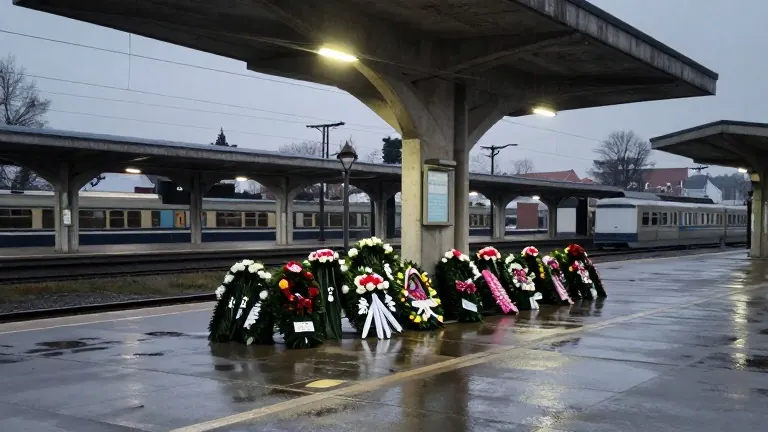
Two years after a concrete canopy collapsed at a railway station in northern Serbia, killing 16 people, thousands of demonstrators gathered in Novi Sad on Sunday. The memorial marked the anniversary of the disaster that ignited a student-led anti-corruption movement. That movement successfully unseated Prime Minister Aleksandar Vucic in parliamentary elections held just one week prior.
The tragedy occurred on November 1, 2024, at 11:52 a.m. A large concrete structure on the station's exterior wall fell without warning, crushing passengers waiting on the platform during a sunny autumn day. Fourteen individuals died at the scene, while two others succumbed to their injuries later. One young woman survived but suffered permanent disabilities.
Protesters arrived at the station under steady rain, marching in silence as a tribute to the deceased. They carried 16 floral wreaths and 16 red hearts, representing each victim. The names of the dead, including several children, were displayed on the station building. Participants placed flowers and lit candles while observers observed a minute of silence. This year's atmosphere differed from the first anniversary, with attendees expressing renewed confidence that those responsible for the collapse would face justice.
Many Serbians attribute the failure of the structure to defective renovation work driven by corruption and negligence. The station upgrade was part of a larger railway reconstruction project involving China and neighboring Hungary. Vucic and Hungarian former Prime Minister Viktor Orban visited the renovated station together in 2022. An independent expert panel concluded that political orders accelerated the renovation schedule. The report stated that Serbia's state violated the right to life of its citizens through a systematic degradation of building standards.
The student movement placed accountability for the collapse at the center of its campaign. Since their victory over Vucic's Serbian Progressive Party, the new student leadership has demanded a review of high-profile investigations. Previously, 13 individuals, including a government minister, were charged in connection with the collapse. However, no trials proceeded because the investigation stalled.
On the same day as the memorial, prosecutors ordered the 48-hour detention of Marko Kricak, the head of Vucic's criminal police. Kricak and another senior officer were held on suspicion of abuse of office regarding an homicide investigation. Kricak has denied accusations that he orchestrated violence during student protests and personally threatened a student with rape.
Andreas von Beckerath, head of the European Union mission in Serbia, noted on social media that the collapse shook the country's foundations. He stated that the event mobilized citizens nationwide to demand transparency and accountability. He added that the memory of the victims should inspire a Serbia built on solidarity and the rule of law.
State television, RTS, broadcast the commemoration ceremony on Sunday. This coverage came after officials resigned from the network following the recent elections. Similar memorials were held in other cities and towns across Serbia.
Source: Pioneer Press