White truffle prices surge 30% as drought shrinks harvest in Italy and Croatia
Hunters in the Alba region report smaller yields and shorter shelf life, while Croatian farmers face an eight-year decline in crop volume.
By Enzo Almasi ·
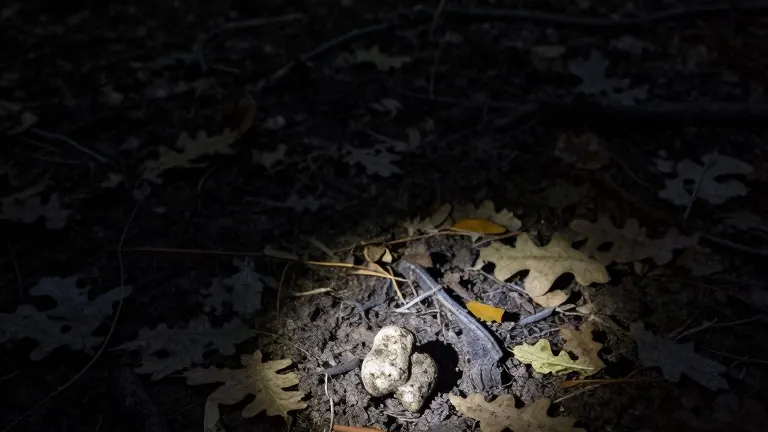
White truffle prices in Alba, Italy, have climbed by 20% to 30% compared to last year, a jump driven by a heat-stressed crop. The increase reflects a tighter supply that has left local hotels largely sold out for the duration of the International White Truffle Fair, which runs from October 10 to December 6.
The price spike follows a summer marked by high temperatures and a lack of rainfall. Antonio Degiacomi, president of Italy’s National Centre for Truffle Studies, noted that the dry conditions in July and August persisted into October. This weather pattern resulted in poor production and reduced the shelf life of the fungus. Degiacomi also pointed to dry, compacted soils as a factor in the smaller size of the truffles emerging this season.
Tino Marolo, a local hunter, works the hills around Alba with his dog, Stella. He describes the hunt as a test of patience, noting that he often returns home empty-handed. Marolo said the uncertainty is part of the thrill, though the frequency of empty hands has increased with the changing climate.
The challenges in Piedmont mirror trends across the Adriatic Sea in Croatia. Petar Alebic, a truffle hunter in oak forests near Zagreb, estimates his harvest is about 30% below normal. He has supplemented his income by leading truffle-hunting tours for tourists. Alebic said that for the past seven or eight years, each season has been worse than the last due to persistent drought.
Scientists in Croatia confirm the decline. Armin Mesic, a mycologist at the Rudjer Boskovic Institute, stated that drought and high temperatures are reducing both the quantity and quality of truffles. He noted that the geographical area where white truffles grow is also shrinking. The white truffle, the most prized species, can sell for up to 4,000 euros, or roughly 4,500 dollars, per kilogram.
Experts in both countries are working on long-term solutions. In Alba, fair president Axel Iberti has expanded the event to include environmental education and conservation. Communities are planting trees to create new public truffle grounds, a process that can take more than a decade before the trees become suitable hosts. Researchers are also studying soil microorganisms and testing experimental irrigation to help habitats adapt to warmer conditions. Degiacomi said the goal is to mimic natural processes artificially to support the fungus.
Source: WTOP News
More Business · Watch Your Wallet · Report a business · Got a Story?