Midterm Pattern Held: Democrats Beat History in CA, Nationally
California's redistricting and national economic discontent drove a historic shift in power, breaking the typical midterm trend for the president's party.
By Chiara Saeed ·
Tuesday's election results confirmed a familiar political cycle: the president's party lost ground, and often significantly. However, the 2026 midterms produced a magnitude of change that surprised even seasoned analysts, with Democrats sweeping both chambers of Congress and gaining control of numerous statehouses. In California, a state without a U.S. Senate race this cycle, voters focused on the open governor's seat and a heavily contested U.S. House delegation. The statewide atmosphere was shaped by a deep dissatisfaction with the status quo, mirroring trends in other battleground states like Texas and Ohio.
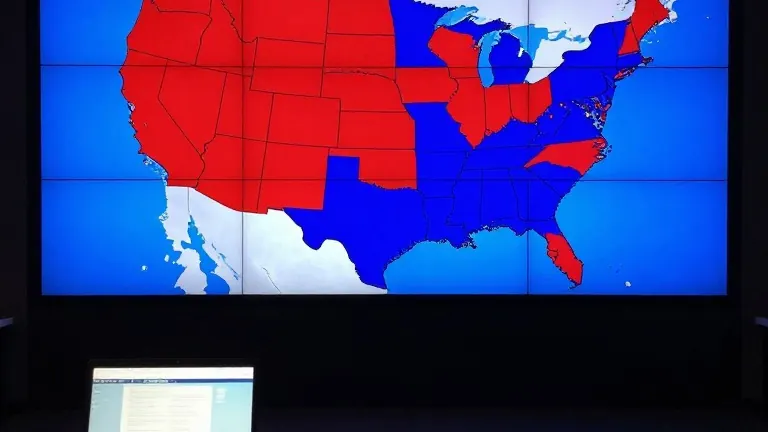
According to Ballotpedia, the midterm elections took place on November 3, 2026, for federal, state, and local offices across the country. The results show a decisive shift in partisan control. Democrats gained a net of seven seats in the U.S. Senate, winning 20 of the 35 races on the ballot. In the U.S. House, Democrats won 233 seats compared to 138 for Republicans, a net gain of 30 seats. This outcome handed Democrats full control of both chambers of Congress, a significant departure from the Republican majorities held in the previous Congress.
The pattern of the president's party losing seats is well documented in American political history. President Donald Trump, a Republican, faced this headwind during his second term. The Associated Press reported that voters were angry over high prices, the war in Iran, and concerns about government corruption. These issues formed the core of the Democratic campaign narrative, which positioned the election as a referendum on the White House. The AP Voter Poll indicated that about six in ten voters disapproved of how Trump was handling the presidency, a sentiment that likely contributed to the broad Democratic gains.
In California, the race for governor was an open seat, meaning no incumbent was on the ballot. The state's polls were open from 7 a.m. to 8 p.m. local time. While the specific winner of the California governor's race was not detailed in the provided source facts, the statewide context was crucial. California underwent mid-decade redistricting, a move that the Associated Press noted was part of a retaliatory response to Republican redistricting in other states. This redistricting flipped previously Republican-held U.S. House seats, contributing to the national Democratic surge.
Two notable U.S. House races in California concluded with Democratic victories, highlighting the impact of the new district maps. In District 22, Randy Villegas (D) defeated incumbent David G. Valadao (R), a race Ballotpedia identified as a battleground. Similarly, in District 34, Angela Gonzales-Torres (D) won, holding the seat for the Democrats. These wins were part of a broader trend where redistricting played a pivotal role. Former Attorney General Eric Holder, chair of the National Democratic Redistricting Committee, stated that the Republican redistricting plan was systematically dismantled and that voters chose to elect a new Democratic majority.
Republicans, for their part, had hoped that their redistricting efforts would provide a defensive edge. At the urging of President Trump, Republicans in eight states redrew congressional district boundaries to create safer seats for their party. The Associated Press reported that this strategy ultimately did not work. In states like Alabama, Florida, and Texas, the redistricting fell flat. In California, the Democratic redistricting offset these efforts. Justin Levitt, a professor at Loyola Law School, noted that it is foolish to presume the electorate in one year will look like the electorate in another during times of radical swings in public opinion.
The national results reflected a wave of Democratic gains in state governments as well. According to Ballotpedia, Democrats won 22 of the 36 gubernatorial races, gaining five governorships from the Republicans. This included pickups in Georgia, Iowa, Ohio, and Texas. In Texas, Democrats took control of the state House for the first time since 2002 and elected Gina Hinojosa as the state's first Democratic governor since 1994. These state-level victories put pressure on the new Democratic leadership to address issues such as the cost of living, housing, and healthcare, which were central to the campaign.
Heather Williams, president of the Democratic Legislative Campaign Committee, described the outcome as historic, noting that Democrats had not flipped this many seats nationwide since the 1980s. She emphasized that the mandate is about kitchen-table issues and economic opportunities. In contrast, President Trump attempted to deflect blame for the losses, telling Fox News that he was not on the ballot and that voters simply did not like the candidates. He also pointed to the war in Iran as a factor, a view shared by Vice President JD Vance, who questioned the cost of the conflict.
The election results set up a divided government in Washington, with Congress poised to reassert itself as a coequal branch ready to challenge the White House. House Democratic Leader Hakeem Jeffries, who is expected to become the first Black speaker of the House, pledged to work hard to deliver on the dramatic change voters requested. Democrats are promising a 100-day agenda that includes efforts to lower the costs of gas and groceries, as well as bills to reverse cuts to healthcare programs. The coming legislative session will likely see major efforts to lighten the tax burden on the middle class and expand access to healthcare.
Mark Jones, a political science professor at Rice University, observed that the Republican congressional redistricting in Texas may have mobilized additional Democratic voters, helping drive gains in the statehouse. He also noted that the primary reason for the Democratic win was the president and his policies. The AP Voter Poll found that roughly one-third of voters said Trump has the right priorities, while about two-thirds said he does not. This sentiment was particularly pronounced among voters in California and other blue states, where dissatisfaction with the country's direction was high.