Trump Rallies in Iowa and Kansas as Midterms Become Referendum on His Second Term
Republicans face defensive races in key states while Democrats in Michigan grapple with internal divisions over the Senate seat.
By Enzo Almasi ·
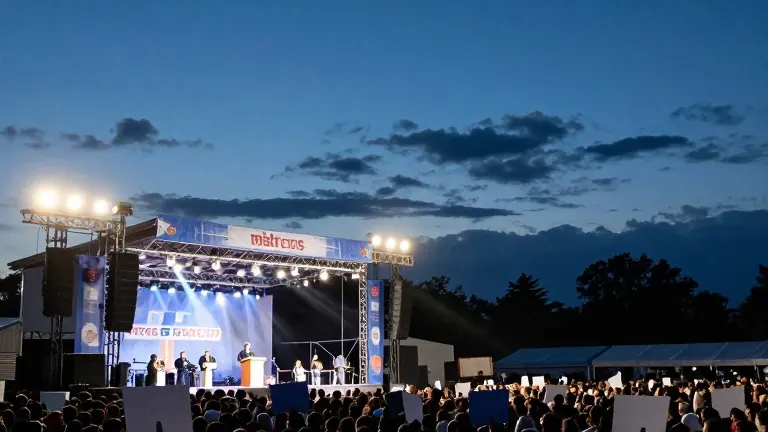
President Donald Trump concluded a two-hour speech in Dubuque, Iowa, on Sunday before traveling to Salina, Kansas, to continue his campaign efforts. These final days of the midterm election feature the president rallying in states he has historically won. Republicans in both locations are defending against strong Democratic challenges that threaten their majority in the Senate and their control of the House.
In Iowa, Trump asserted that his party is positioned for a sweep on Tuesday. He told the crowd, “We’re going to elect ‘America first’ Republicans up and down the line.” With more than 54 million votes already cast, the president’s itinerary reflects a defensive strategy for the Republican Party. The election has evolved into a direct test of his second-term record, particularly regarding economic policies and foreign affairs.
The political strategy differs markedly from the 2024 campaign. Then, Trump focused on flipping states that had voted for Joe Biden in 2020. This year, the president is concentrating on states where he previously dominated, even as some former supporters question the impact of his tariffs and the war in Iran on the economy.
Democratic efforts in Michigan, a critical state for retaking the Senate, faced complications on Sunday. Haley Stevens, the former primary opponent of Abdul El-Sayed, appeared with Republican candidate Mike Rogers at a church service. Stevens later endorsed Rogers, stating that El-Sayed had told her she was “no longer welcome in his campaign.”
Stevens said in a video announcement, “And he’s right. And that’s why I am endorsing Mike Rogers for the United States Senate today.” The move prompted other Democratic leaders to reaffirm their backing of El-Sayed. Senate Majority Leader Chuck Schumer said the party was “united in our support.” Kirsten Gillibrand, the top Democrat in the Senate, added that the party would “reject any efforts to divide Democrats.”
Bernie Sanders, a prominent supporter of El-Sayed, downplayed the split. On CBS’ “Face the Nation,” Sanders noted that Stevens lost a close primary but observed that people across the state are standing with El-Sayed. Losing Michigan would force Democrats to win races in deeper red states like Texas, Ohio, Kansas, or Iowa to secure a Senate majority.
The campaign’s final stretch is testing Trump’s influence over the Republican base. In Dubuque, voter Jon Lutz, a 60-year-old civil engineer attending his first rally, said he wants Republicans to keep control of Congress to advance Trump’s agenda. “He’s done what he’s said he’s going to do,” Lutz said. Another first-time attendee, Wendy Kuenzler, a 44-year-old from Burlington, said she does not blame Trump for rising gas and grocery prices, noting he is on the path to correcting the issues.
Democratic nominee for governor in Iowa, Rob Sand, held multiple events across the state on Sunday to counter the Republican momentum. Trump’s recent rallies in October have sometimes been distracted by his off-topic remarks and descriptions of candidates. On Saturday, the president paused his schedule to attend a Halloween party at Mar-a-Lago in Florida, where he told guests, “The country has never done better.”
Outgoing Representative Don Bacon of Nebraska expressed concern that tariffs could hurt Republican prospects in the Midwest. “Tariffs are not popular here in the Midwest,” Bacon told CNN’s “State of the Union.” He predicted a debate within the party if losses occur. In contrast, Senator Tim Scott of South Carolina, the chairman of the National Republican Senatorial Committee, expressed confidence that Republicans will retain the Senate. “His agenda, without any question, is on the ballot,” Scott told NBC’s “Meet the Press.”
Source: The San Diego Union-Tribune