Midterm math: How parties in California and beyond fight the historical seat loss
With polls open from 7 a.m. to 8 p.m., both parties deploy redistricting and high spending to counter the trend of the president's party losing seats.
By Chiara Saeed ·
Voters across California and the nation are casting ballots on Tuesday, November 3, 2026, in a midterm election that serves as a referendum on the second term of President Donald Trump. The Associated Press describes the day as a critical moment where the results will determine which party controls Congress for the president's final two years. All 435 seats in the U.S. House are up for grabs, while 35 of 100 Senate seats are in play. Additionally, 36 governorships are on the ballot, with Republicans holding 26 offices and Democrats holding 24 heading into the election.
The historical pattern of midterm elections suggests that the president's party almost always loses seats. In this cycle, Republicans hold 218 House seats and Democrats hold 214, with one independent. Democrats need a net gain of three districts to secure a majority, while Republicans can afford to lose no more than two. For the Senate, Democrats require a net gain of four seats to take control, a margin that allows Republicans to lose only two seats. This narrow margin means that a few districts in battleground states could decide the balance of power in Washington.
Both parties have employed aggressive strategies to beat this historical trend. Republicans have relied on redistricting in states like California, Florida, and Texas, where new congressional maps were drawn after mid-decade redistricting. The Associated Press notes that 88.1% of Republican general election TV ad spending went to states and districts Trump won in 2024, including more than $850 million in areas where he won by 10 points or more. This spending was supported by Trump-affiliated groups and Elon Musk, helping Republican committees outspend their Democratic counterparts at the committee level.
Democrats, meanwhile, have focused on turnout and local spending. While Republican committees outraised Democrats, Democratic candidates outraised their opponents at the individual level. Rep. Suzan DelBene, the chair of the Democratic Congressional Campaign Committee, stated that the American people are angry and want change. In contrast, RNC Chairman Joe Gruters emphasized the importance of turnout, saying that if the party turns out its voters, they will win. The Associated Press reports that more than 57 million people had already voted as of Monday, surpassing the early vote totals of four years ago in many closely watched states.
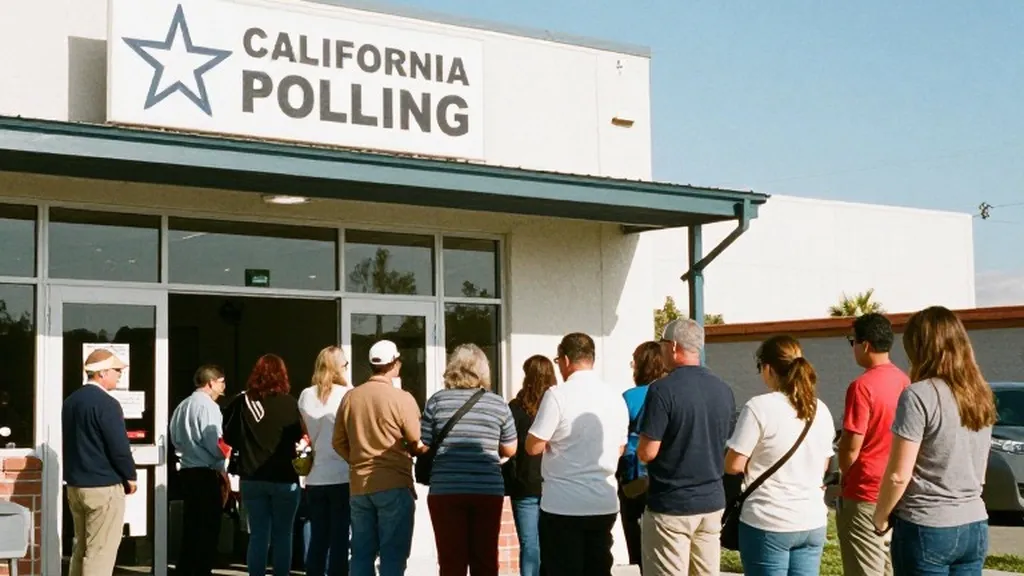
California plays a significant role in this midterm pattern, particularly in the House races where voters use new congressional maps. The state polls are open from 7 a.m. to 8 p.m., and the election is largely conducted by mail. There is no Senate race in California this year, but there is an open seat for governor. The Associated Press notes that the Trump administration filed a lawsuit related to the certification of the Senate result in Alaska and also sued in California regarding voting procedures. A federal judge ordered the administration on Monday to stop demanding that California election officials segregate ballots cast by people on its lists of suspected noncitizens, a move critics say risks disenfranchising eligible voters.
The mood in the country is shaped by economic concerns and an unpopular war with Iran. AP-NORC polling indicates that 35% of U.S. adults approve of Trump's job performance, while only 25% approve of his handling of the economy. About seven in 10 Americans say the country is heading in the wrong direction, with most blaming the president for high prices. Voter James Moore, a librarian in Raleigh, North Carolina, expressed these frustrations, noting that he is paying more for taxes, healthcare, and everyday goods. This sentiment is driving the Democratic campaign, which aims to capitalize on voter dissatisfaction to gain seats in both chambers.
Republicans are bracing for the possibility of losing the House and are fighting to hold the Senate. The Associated Press notes that one or two seats could tip either chamber, making the race for control extremely tight. Trump held dozens of rallies, ending in Salina, Kansas, where he urged voters to pretend he was on the ballot. His administration has also continued to make claims about voting fraud, including the assertion that noncitizens vote in large numbers. These claims have led to legal battles and fears of interference among Democrats, who are watching closely as the Justice Department threatens to prosecute local election officials.
In the governor's races, Democrats are hoping to hold a majority of governorships for the first time in two decades. Heading in, each party holds 18 of the governorships on the ballot. Democrats defend five governorships in states Trump won in 2024, including Arizona, Kansas, Michigan, Pennsylvania, and Wisconsin. Republicans defend two in states Harris won: New Hampshire and Vermont. The Associated Press identifies Texas, Florida, and Iowa as competitive governor races. In Nevada, Republican Gov. Joe Lombardo faces Democratic Attorney General Aaron Ford, while in Georgia, Republican health care executive Rick Jackson faces Democratic former Atlanta Mayor Keisha Lance Bottoms.
The stakes extend beyond the immediate control of Congress. If Democrats win even one chamber, investigations and possible impeachment proceedings become likely. House Democratic Leader Hakeem Jeffries would be the first Black speaker if his party takes the House and has outlined a 100-day agenda focused on the cost of living and oversight. A strong Democratic night would also boost potential 2028 candidates such as Gavin Newsom, JB Pritzker, and Pete Buttigieg, while potentially complicating the path for Vice President JD Vance. Wall Street is also watching the results, as Reuters notes that the outcome could add to investor concerns about AI spending and debt ceiling negotiations.